
Author: Reinhold Steinbeck

  • SESI Santa Catarina works with IntoActions to improve bike safety on the Stanford Campus

    SESI Santa Catarina works with IntoActions to improve bike safety on the Stanford Campus

    Introducing Human-Centered Design Through a Real-World Challenge

    How do you introduce Human-Centered Design to participants in a 3-day Boot Camp on Design Thinking promoting bike safety on the Stanford campus? You put them on bikes, hand out helmets, give them some instructions and then send them off towards the ‘circle of death’ during rush hour.

    Last week I worked with the MediaX Program at Stanford University to deliver a three-day design thinking bootcamp for one of their Affiliate Members from Brazil, SESI-SC.

    About the Partners

    MediaX is the industry affiliate program of the H-STAR Institute and helps its members to explore the use of technology to improve the human experience in a range of fields, from entertainment to learning to commerce.

    SESI-SC is the Serviço Social da Indústria, the Social Services Organization of the Brazilian Industry, and is based in the State of Santa Catarina in Southern Brazil. SESI-SC is particularly interested in technology to improve safer and healthier human behavior.

    Using Real Challenges to Teach Design Thinking

    When we run our multi-day design thinking bootcamps at IntoActions, we always have a client that provides us with an authentic field challenge. We then use that challenge as a vehicle to introduce the design thinking process, key principles, tools and techniques which gives participants an opportunity to work in teams and learn by doing.

    Deputy Adam Cullen from Stanford’s Department of Public Safety presents the challenge to the Brazilian delegation. Image Credit: © IntoActions. Photo by Reinhold Steinbeck

    Improving bike safety on the Stanford campus was the ideal challenge to use for this boot camp, and our client was Stanford’s Department of Public Safety. Not only was bike safety closely connected to SESI’s interest in issues related to work safety and health, but it is also a major concern for the Department of Public Safety.

    There are close to 20,000 bikes on the Stanford campus, and the Department estimates that more than 300 cyclists are seriously injured while riding on campus each year.

    The Challenge: Key Issues in Bike Safety

    Deputy Adam Cullen, who presented the challenge to the SESI-SC delegation at the beginning of the boot camp on behalf of the Department of Public Safety, mentioned that there are primarily three main issues related to bike safety:

    • many students are not wearing bike helmets
    • a large number of bikes don’t have lights
    • and bikers don’t obey stop signs and other traffic rules

    Day 2: Understanding the Problem Space

    During the second day of our boot camp, participants applied various design thinking tools and techniques to better understand the problem space. They:

    • interviewed dozens of bicyclists, pedestrians and car owners
    • used their mobile phones and cameras to capture bikers in action
    • focused on hot spots on campus, such as the new roundabouts that students are referring to as the ‘circles of death’
    • recorded several bike accidents during their field research
    Picking up the bicycles and getting ready for the immersion. Image Credit: © IntoActions. Photo by Reinhold Steinbeck

    Building Empathy Through Immersion

    To build empathy for the key stakeholders – in this case the bikers, the pedestrians and the car owners – it is not enough to speak with and observe them. We also asked the participants to immerse themselves to better understand the situation that the key stakeholders are in, and for which they were tasked to design a solution.

    They had already been pedestrians on campus during the previous days, and they have experienced what it’s like to weave through thousands of bikes during the change of classes.

    On the second day, we:

    • rented bikes for all participants
    • gave them helmets and an introduction to campus and some of the key issues related to bike traffic and safety
    • sent them off for three hours to experience what it’s like to be a biker on campus

    We refer to this approach of understanding the problem space as the ‘triangulation for empathy’:

    1. What people say they are doing.
    2. What people are doing?
    3. What people are experiencing.
    Participants experienced what it’s like to cross the campus on a bike during ‘rush hour.’ Image Credit: © IntoActions. Photo by Reinhold Steinbeck

    Synthesizing Insights

    After their ‘field immersion’ the teams stayed within the context and used various tools and techniques to ‘unpack’ and organize the information that they collected.

    One of the key takeaways from their field research was that designing a bike safety solution was much more than creating innovative helmets or lights.

    Participants are working outside the Stanford bike shop to unpack the data they collected. Image Credit: © IntoActions. Photo by Reinhold Steinbeck

    Final Presentations & Insights

    At the end of the three-day boot camp the solutions created by the SESI-SC teams were presented to the Department of Public Safety.

    Rick Rondeau, a sergeant with the Department, was particularly impressed by a helmet that would fold like an umbrella. The insight that the team walked away with from their field research was that:

    • students don’t like to carry their bulky helmets with them to class, and
    • when they attach them to their bikes, they might get stolen.

    The connection to using an umbrella was an excellent analogy, a powerful technique with design thinking for developing unique user insights.

    At the end of the three-day, hands-on, immersive workshop, participants presented their solutions to Rick Rondeau, a sergeant with the Department of Public Safety. Image Credit: © IntoActions. Photo by Reinhold Steinbeck

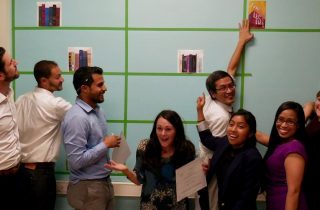
    Featured Image: Image Credit: © IntoActions. Photo by Reinhold Steinbeck

  • Strategic Human-Centered Design Innovation at the Universidad Católica del Uruguay (UCU)

    Strategic Human-Centered Design Innovation at the Universidad Católica del Uruguay (UCU)

    Key Questions

    In a fast moving world, how can we build fast moving and agile universities? How can we better align universities with the contemporary needs of students and other stakeholders? How can we build a holistic, human-centered strategic innovation model for universities?

    Strategic Human-Centered Design Innovation at the Universidad Católica del Uruguay

    IntoActions worked with the Universidad Católica del Uruguay (UCU) in South America to help the university align its strategic goals with Human-Centered Design (HCD) and build organizational innovation capacity. The initiative’s outcome was a framework that became the foundation of UCU’s new five-year strategic plan.

    IntoActions’ group processes allowed the mapping and alignment of over 4,000 ideas and comments in a strategic framework during the workshops. Photo Credit © UCU

    Three-Stage Strategic Innovation Capacity-Building Process

    IntoActions’ highly participatory and collaborative program guided participants through the three stages of its strategic innovation capacity-building process

    1. Strategic Innovation Planning: Mapping a strategic framework that aligned UCU’s processes, technology, people, and structure with its vision and strategic goals.
    2. Design Thinking Deep Dive: Crafting and implementing a Design Thinking Deep Dive, a human-centered design activity that allowed for a more in-depth discovery of essential insights based on the university’s vision and strategic goals.
    3. Implementation: Turning unique insights into actions by creating and implementing innovative prototype solutions—then leveraging this practice to build ongoing innovation capacity.

    Why This Approach Matters

    Integrating strategic innovation planning with human-centered design helped participants to learn, discover, and experiment with intention. It encouraged them to keep goals and critical questions in view while applying a deep exploratory and creative process.

    What do universities want to achieve for their students and stakeholders in a socially and technologically fast moving world?

    IntoActions conducted a series of participative workshops that included:
    senior academics students members of the executive team senior management
    administrative staff. There were numerous advantages to using our participative approach.

    We had 80 “end-to-end” representatives from across the university in the same room. Cross-functional participation with students meant that we could create a strategic transformational framework in less than four weeks.

    Students working alongside with senior academics, members of the executive team, senior management, and administrative staff during the strategic human-centered design innovation workshop. Photo Credit © UCU

    Strategic Mapping & Holistic Innovation Model

    IntoActions’ group processes allowed the mapping and alignment of over 4,500 ideas and comments in a strategic framework during the workshops. Our holistic strategy model can also be used, in more detail, for aligning organizational structure, technology architecture, asset, and cost distribution.

    Workshop Outputs

    The outputs for the workshops included:

    • Introducing a holistic HCD strategy model and training all participants in how to use the model
    • Aligning HCD and strategy with people, process, and technology
    • Clarifying and agreeing on key areas for strategic transformation
    • Conducting a two-week human-centered deep dive into the top eight strategic issues and then building prototype solutions
    • Introducing a basic framework for HCD project implementation

    IntoActions’ participative HCD approach allowed UCU to map information, create a strategic framework and strategic agreement, and develop strategic prototype solutions that traditionally take elapsed time of three to six months.

    Reinhold Steinbeck and Ian Hunt, IntoActions’ project leads for UCU’s strategic human-centered design initiative, with Fr. Dr. Julio Fernández Techera, SI, UCU’s Rector, and participating students. Image Credit: © IntoActions. Photo by Reinhold Steinbeck

    “IntoActions led over 80 participants through a 4-week participatory human-centered strategic design workshop at the Universidad Católica del Uruguay (UCU).

    The experience was extraordinary in many ways—for its novel approach that energized the organization internally; for the inclusion of all key stakeholders, including 20 students, throughout the entire process; for its hands-on and practical approach; and for its results.

    The workshops were very successful and good for UCU’s heart and soul, and already left a lasting rhythm of innovation.”

    Dr. Julio Fernández Techera, S.I. Rector,
    Universidad Católica Del Uruguay | UCU

    Featured Image: © UCU

  • IntoActions and Social Good Brasil collaborate with the Miller Center for Global Impact

    IntoActions and Social Good Brasil collaborate with the Miller Center for Global Impact

    First Encounter with GSBI

    I still remember the first time that I visited Santa Clara University, the Jesuit University in Silicon Valley, just south of Stanford, in August of 2005. It was the second time the University’s Global Social Benefit Institute (GSBI)—now the Miller Center for Global Impact—had invited local investors, donors, advisors, mentors, and guests to its Investor Showcase. It was an amazing event where 20 social entrepreneurs from around the world pitched their ideas for their social enterprises.

    I was focusing my work on the use of innovation in learning at the time. One of the projects that stood out was Asociación Ajb’atz’ Enlace Quiche, which had developed low-cost, bilingual, intercultural technology centers for indigenous communities across Guatemala. The project, headed by Andy Lieberman, was not only selected to participate in GSBI’s 9-day In-Residence Program in Silicon Valley. It had also won the Microsoft Education Award at the Tech Awards, organized by the Tech Museum of Innovation in Silicon Valley. This was an amazing track record.

    GSBI 10 Years Later

    Now, 10 years later, GSBI has become a global leader in supporting social entrepreneurs from around the world. GSBI’s programs help these entrepreneurs develop innovative solutions that provide a sustainable path out of poverty. Andy is now heading GSBI’s New Program Initiatives.

    GSBI Programs

    These initiatives include the Boost Program, a 3-day workshop for start-up stage social entrepreneurs to learn business fundamentals and improve their strategic thinking. The key benefit of this program is the creation of a business plan that demonstrates impact, growth, and long-term financial sustainability.

    Other programs that GSBI offers include:

    • GSBI Online – a 6-month long program for early stage social entrepreneurs
    • GSBI Accelerator – a 10-month long program for mid-stage entrepreneurs, including a 9-day residential phase in Silicon Valley

    You can learn more about the GSBI programs here.

    Expanding GSBI Boost to Brazil

    Over the past 12 months, Andy and I have been exploring ways to expand GSBI’s Boost Program to Brazil. Last week, with the support of the eBay Inc Foundation, GSBI was able to bring two members from Social Good Brasil (SGB) to Silicon Valley.

    Social Good Brasil is the leading accelerator program for social entrepreneurs in Brazil. IntoActions has collaborated closely with Social Good Brasil since 2013, providing capacity-building programs in Human-Centered Design (HCD) for over 250 social entrepreneurs participating in Social Good Brasil’s program.

    We are very excited to work with both organizations to leverage GSBI’s programs and strengthen social entrepreneurship across Brazil.

    Fernanda Bornhausen, Co-Founder, and Barbara Basso, Coordinator, Social Good Brasil Lab. Image Credit: © IntoActions. Photo by Reinhold Steinbeck

    Social Good Brasil at the Boost Xchange Workshop

    Barbara Basso, the Coordinator of the Social Good Brasil Lab, and Fernanda Bornhausen, Co-Founder and Volunteer President of Social Good Brasil, joined directors and staff from six other organizations in a three-day Boost Xchange workshop where they learned the ins and outs of the program in order to adapt and implement it later in the year in Brazil.

    Organizations that participated in the GSBI Boost Xchange Program in addition to Social Good Brasil included:

    • Alterna Impact, Guatemala
    • Child and Youth Finance International Ye! Community, Netherlands (Partners in Ghana, Kenya, Philippines)
    • Momentum Project, ESADE Business School, Spain (Partners in El Salvador)
    • Marquette University Social Innovation Initiative, USA
    • Minga Social Enterprise Arena, Israel
    • POSiBLE, Mexico
    Participants in the GSBI Boost Xchange Program. Image Credit: © IntoActions. Photo by Reinhold Steinbeck

    “We have been working with IntoActions since 2013. They are our lead partner concerning the methodology behind our accelerator program. They have challenged our participants to question their assumptions, adjust their mindsets, and apply new tools and techniques to develop better solutions. In the process, our participants quite often redefine what the real social problem is that they want to address, or who the actual users are.”

    Carolina de Andrade, Executive Director
    Social Good Brasil
    Florianópolis, SC, Brazil

    IntoActions trained over 250 early-stage entrepreneurs in human-centered design over three years, partnering with Social Good Brasil, Brazil’s largest social-technical accelerator, training

    Featured Image: © 2019 IntoActions. Image by Reinhold Steinbeck

  • Scaling Innovation Capacity at the Organizational Level: The iLab at the San Francisco Unified School District

    Scaling Innovation Capacity at the Organizational Level: The iLab at the San Francisco Unified School District

    The iLab at the San Francisco Unified School District

    • How can we cultivate a culture of academic excellence among African-American female students?
    • How can we engage teachers in data-informed conversations to accelerate student academic growth?
    • How can we transform teacher and family relationships?

    These are just some of the challenges being addressed through the iLab initiative at the San Francisco Unified School District (SFUSD)—one of the largest efforts in the United States to apply design thinking as a human-centered problem-solving approach in K–12 education.

    The overall goal of the iLab is to build institution-wide, strategic human-centered innovation capacity across the entire DistrictOver a two-year period, IntoActions worked closely with the iLab program team to help SFUSD put design thinking into action, refine its human-centered innovation methodology, and strengthen its innovation coaching and implementation model at scale.

    SFUSD Design Team. Image Credit: © IntoActions. Photo by Reinhold Steinbeck

    Promoting Innovation Across an Entire Organization

    At IntoActions, we are passionate about working closely with our partners to help them identify unique insights related to the challenges they are trying to solve—and to transform those insights into compelling ideas. But we don’t stop there.

    As the name IntoActions suggests, we work with partners to turn innovative ideas into action. Innovation, in our view, means more than coming up with a good idea. It means taking ideas home, trying them out, refining them, and embedding them into daily practice. For innovation to take hold, structures and processes must be established to promote innovation systemically across an entire organization—not just within isolated teams.

    The iLab was established as part of SFUSD’s strategic plan Vision 2025, a district-wide effort engaging hundreds of stakeholders—teachers, administrators, students, families, community-based organizations, and academic experts. The iLab was envisioned as “a space, a process, and a resource” to promote innovation so that all SFUSD students graduate ready to thrive in the 21st century.

    This top-down strategic commitment has been matched by growing bottom-up interest from educators eager to design and implement innovative approaches to real, day-to-day challenges.

    A Shared Framework, Language, Process, and Support System

    SFUSD’s Design Thinking Framework

    SFUSD’s Design Process draws on proven methods from IDEO.org, the Stanford d.school, and IntoActions and is organized around four interconnected areas and phases that constantly interact with each other: Discover, Define, Develop, and Deliver.

    • Discover: During the Discover phase, teams explore and begin to understand the problem space by engaging deeply with students, teachers, families, and other stakeholders.
    • Define: The Define phase brings clarity to complexity by synthesizing observations, identifying needs, and generating unique insights. This phase helps teams to (re)define what the real problem is.
    • Develop: The Develop phase pushes teams to use a wide range of ideation tools and methods to generate many possible solution pathways.
    • Deliver: Finally, the Deliver phase requires teams to build, test, and refine the most promising solutions in real-world contexts.

    Throughout the process, activities continually alternate between the problem space and the solution space, with increasing levels of fidelity. Through rapid and repeated prototyping, ideas quickly move from the abstract to the concrete and are transformed into tangible solutions. Failure is encouraged at any point, as many of the best solutions begin with surprise and learning from what did not work as expected.

    IntoActions Design Thinking Framework

    Training and Coaching

    Shortly before the school year began, project teams committed to attending a Bootcamp, a short hands-on introduction to the Design Thinking Process. The Bootcamp was followed by four Design Sessions during September and October, culminating in the end of the first phase with a Pitch Night in November, where the teams presented their solution.

    Each team was assigned an iLab Coach, a facilitator trained in human-centered design principles and processes, who supports the team throughout the design process. iLab Coaches might be experienced ‘design thinkers’ from within the District, as well as external design experts. iLab Coaches had access to weekly coaching “office hours” with the iLab leadership team. After Pitch Night, iLab Coaches continued to work with their teams during the implementation phase, though less regularly.

    Innovation Space

    Space matters! Space defines desired behaviors and shapes desired learning. The physical space used for the iLab project is a key instrument in fostering innovation and collaboration. For this initiative, SFUSD converted four classrooms at the Thurgood Marshall Academic High School into a stage for creative team collaboration. Flexible furniture, prototyping tools and materials, visualization aids and other elements encourage teams to take a playful approach to creative problem-solving.

    Some teams decided to work at their own school rather than using the iLab space. While there are some advantages to working in their own space, teams might miss out on the unique affordances of the iLab space and the energy of being located in the same space as other design teams.

    SFUSD iLab flexible learning space. Image Credit: © IntoActions. Photo by Reinhold Steinbeck

    Additional Resources and Requirements

    Each team invited to participate in the iLab project received prototyping funds ranging from $2,500 to $5,000. After presenting their solutions during Pitch Night and submitting an implementation plan and budget, teams also received implementation funds averaging $10,000. Faculty and staff team members are also granted paid time off for their work on the innovation project.

    The Stanford University Graduate School of Education was also engaged as a research partner. Stanford graduate students and faculty were conducting research to assess the impact and effectiveness of the iLab project.

    Having coached school teams throughout multiple phases of the iLab initiative provided IntoActions with a unique perspective into how district-level strategy, shared frameworks, and coaching structures translate into sustained innovation at the school level.

    Case Study: Increasing Engagement in Learning for All Students

    César Chávez Elementary School

    One example of the iLab in action is César Chávez Elementary School, located in the heart of San Francisco’s Mission District—a historically working-class Hispanic neighborhood undergoing rapid gentrification. The school is designated as one of SFUSD’s Historically Underserved Schools, with close to 80% of students identified as English language learners. Over 80% of students come from low-income families, and 24% have Individualized Education Programs (IEPs).

    The Challenge

    A persistent challenge at César Chávez has been finding effective ways to increase engagement in learning for all students. Many students perform below grade level and easily become discouraged or disengaged. Compounding this are external stressors, including fear of displacement or deportation.

    While the value of collaborative and project-based learning (PBL) was well understood and discussed among staff, the practical challenge of designing and implementing group work that truly engages all learners—across grades and classrooms—remained significant.

    SFUSD Design Project. Image Credit: © IntoActions. Photo by Reinhold Steinbeck

    The Design Team & Process

    The six-member design team included the school principal, a curriculum and technology integration specialist (who served as team lead), and four classroom teachers representing all grade levels. After an intensive two-month design deep dive, the team spent the remainder of the school year testing, refining, and implementing their solution, supported throughout by an experienced design thinking coach.

    By engaging students, teachers, and families, the team surfaced a key insight: students were most engaged when learning culminated in shared celebrations. Opportunities to collaborate and publicly share learning—inside and outside of school—dramatically increased motivation and engagement.

    The Solution: Learning Showcases as a Catalyst for PBL

    The team identified Learning Showcases as a powerful vehicle to infuse project-based learning across grade levels. Learning Showcases provided a clear entry point, a shared purpose for teachers, and a meaningful audience for students.

    Innovation Award funding enabled release time for grade-level teams to plan and implement several Learning Showcase prototypes at the end of the school year. Student engagement, enthusiasm, and joy of learning were noticeably stronger.

    SFUSD Learning Showcase. Image Credit: © IntoActions. Photo by Reinhold Steinbeck

    Preliminary Impact & Moving Forward

    All classrooms incorporated project-based learning elements into their final writing spiral. Teachers reported increased collaboration across grade-level teams, more hands-on learning, greater student choice, and higher levels of creativity and engagement.

    • 75% of teachers reported that their final spiral project went well or very well
    • 91% of teachers reported that students were engaged or very engaged

    As one teacher noted, “The teamwork and application of new learning was really cool,” while others described “lots of great collaboration… and kids making connections across classrooms.”

    Building on these early successes, César Chávez plans to expand Learning Showcases in the following school year, working with internal and external partners—including the Buck Institute for Education—and integrating principles from Complex Instruction, a Stanford-based approach designed to promote equity and engagement in heterogeneous classrooms.

    The Principal of César Chávez Elementary School welcoming students in front of one of several brightly colored murals that jump out at passers-by from all sides of this elementary school in San Francisco’s Mission District. Image Credit: © IntoActions. Photo by Reinhold Steinbeck

    From Individual Schools to Institution-Wide Change

    The César Chávez case illustrates how sustained, multi-year investment in human-centered design—supported by shared language, coaching, leadership commitment, and enabling structures—can help a large public school district build lasting innovation capacity.

    Through its two-year collaboration with the iLab, IntoActions supported SFUSD in moving beyond isolated innovation projects toward institution-wide, strategic human-centered innovation, grounded in the realities of classrooms, schools, and communities.

    Photo Gallery

    SFUSD End-of-Year Showcase. Image Credit: © IntoActions. Photo by Reinhold Steinbeck
    SFUSD Design Project. Image Credit: © IntoActions. Photo by Reinhold Steinbeck
    SFUSD End-of-Year Showcase. Image Credit: © IntoActions. Photo by Reinhold Steinbeck
    SFUSD End-of-Year Showcase. Image Credit: © IntoActions. Photo by Reinhold Steinbeck
    SFUSD End-of-Year Showcase. Image Credit: © IntoActions. Photo by Reinhold Steinbeck
    SFUSD End-of-Year Showcase. Image Credit: © IntoActions. Photo by Reinhold Steinbeck
    SFUSD End-of-Year Showcase. Image Credit: © IntoActions. Photo by Reinhold Steinbeck
    User Testing at the SFUSD End-of-Year Showcase. Image Credit: © IntoActions. Photo by Reinhold Steinbeck

    Featured Image: Image Credit: © IntoActions. Photo by Reinhold Steinbeck

  • IntoActions and dGlobal at Stanford: Bringing the Stanford Design Way to You

    IntoActions and dGlobal at Stanford: Bringing the Stanford Design Way to You

    Helping teams anywhere in the world learn the Stanford Design Way

    IntoActions and the dGlobal at Stanford program are joining forces to help groups anywhere in the world learn the Stanford Design Way and apply it to their local context.

    dGlobal is a 6-week online course, designed to reinforce key concepts based on the enduring practices from the award-winning ME310 design course and leveraging research from the Stanford Center for Design Research (CDR) and the HPI-Stanford Design Thinking Research Program. dGlobal is administered by the Stanford Continuing Studies Program.

    HPI-Stanford Design Thinking Research Program

    Building Innovative Teams

    How do the best teams work? What practices support a highly innovative team?
    This cutting-edge hybrid program is designed around how people truly learn – through a blend of practice, reflection, and reinforcement.

    Step 1. Practice

    In a flipped model of learning, you organize any event or workshop to provide participants with an initial exposure to group collaboration and design teamwork.

    Step 2. Reflect

    Interested participants can then submit a mini e-portfolio in which they reflect on their teaming experience through words and photos.

    Step 3. Reinforce

    Participants then enroll and participate in a Stanford 6-week online course, designed to reinforce key concepts based on the enduring practices from the award-winning ME310 design course, taught at Stanford since 1967.

    Course Topics

    • Create a learning culture
    • Building T-Teams
    • Collaborating versus coordinating
    • Why build to think
    • Three horses
    • All design is redesign

    Benefits & Cost

    Participants who complete all three parts earn an official Stanford University transcript and 1 unit of Stanford Continuing Studies credit for DSN300W. They also join the Continuing Studies Program alumni community.

    Tuition for the 6-week course is USD $400 per person, payable to Stanford.
    Expected course load is approx. 3 hours weekly.

    The online course can be combined with a hands-on workshop at the Silicon Valley Innovation Studio in San Francisco or at the participants’ location.

    “Your Stanford University program, dGlobal at Stanford: Bringing the Stanford Design Way to You, has helped me and my colleagues think more strategically about entrepreneurship, innovative teams, and project-based learning. It has already led to some new ideas that we will implement with our next cohort at the Programa de Pre-Incubación UTEC.”

    Antonella Montes de Oca, Program Director, Technological Entrepreneurship Program
    Universidad Tecnológica del Uruguay (UTEC)
    Montevideo, Uruguay

    Featured Image: dSchool at Stanford University. Image Credit: © IntoActions. Photo by Reinhold Steinbeck

  • Innovation Labs for Early-Stage Entrepreneurs and Young Graduates in Saudi Arabia

    Innovation Labs for Early-Stage Entrepreneurs and Young Graduates in Saudi Arabia

    Building Innovation Capacity

    Since 2021, IntoActions has led a series of multi-week Innovation Labs for early-stage entrepreneurs and emerging innovation leaders from Saudi Arabia. These hands-on, immersive, team- and project-based programs have been delivered in both Riyadh and Silicon Valley.

    The Innovation Labs are designed as intensive learning experiences that combine real-world challenges with practical tools drawn from design education and the learning and cognitive sciences. Participants work in teams, learn by doing, and apply new ideas directly to authentic problems.

    Innovation Lab Participants in Riyadh. Image Credit: © IntoActions. Photo by Reinhold Steinbeck

    The primary goal of the Innovation Labs is to equip young Saudi graduates and early-stage entrepreneurs with practical strategic innovation skills and the confidence to apply them in real-world contexts.

    Key Learning Objectives

    By the end of the Innovation Labs, participants are able to:

    • Explain the four phases of the design thinking process and how they connect from start to finish
    • Frame real-world challenges by observing users, conducting interviews, and questioning initial assumptions
    • Use idea-generation techniques to move beyond obvious or first-pass solutions
    • Create low-fidelity prototypes—such as sketches or simple models—to make ideas tangible and learn quickly
    • Communicate ideas through clear, human-centered stories that engage and motivate others
    • Build confidence in their own creative abilities through rapid, low-risk experimentation
    • Practice a curious leadership mindset by using questions to challenge assumptions and unlock others’ ideas
    • Build trust and psychological safety by listening carefully, staying present, and knowing when to step in—or step back
    • Apply an integrated approach that connects strategic thinking, human-centered design, and implementation
    Innovation Lab Participants in Riyadh. Image Credit: © IntoActions. Photo by Reinhold Steinbeck

    Featured Image: Innovation Lab Participants during a field visit in Riyadh.
    Image Credit: © IntoActions. Photo by Reinhold Steinbeck